
Lake Hopatcong At Landing Nj Reservoir Report
Last Updated: December 8, 2025
Lake Hopatcong is located in the Landing area of New Jersey and has a rich history, dating back to the 1700s.
°F
°F
mph
Wind
%
Humidity
Summary
The lake is a man-made reservoir created by the Morris Canal, and it serves as a primary source of drinking water for the local communities. The lake is fed by several small streams and is connected to the Musconetcong River. The hydrology of the lake is influenced by both surface water flow and snowpack. The surface flow comes from precipitation and runoff, while the snowpack provides a slow and steady melt throughout the spring. The lake is used for a variety of recreational activities, including boating, fishing, and swimming. It also serves as a source of irrigation for local agriculture.
Reservoir Details
| Gage Height, Ft 24hr Change | -0.13% |
| Percent of Normal | 108% |
| Minimum |
3.73 ft
2013-11-26 |
| Maximum |
10.7 ft
2011-09-09 |
| Average | 7 ft |
| Dam_Height | 17 |
| Drainage_Area | 25.4 |
| Year_Completed | 1925 |
| Nid_Storage | 48209 |
| River_Or_Stream | Musconetcong River |
| Primary_Dam_Type | Concrete |
| Surface_Area | 2474 |
| Hazard_Potential | High |
| Dam_Length | 271 |
| Nid_Height | 17 |
Seasonal Comparison
Gage Height, Ft Levels
Weather Forecast
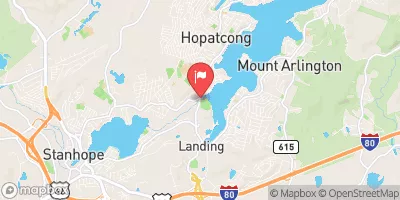
Nearby Streamflow Levels
Dam Data Reference
Condition Assessment
SatisfactoryNo existing or potential dam safety deficiencies are recognized. Acceptable performance is expected under all loading conditions (static, hydrologic, seismic) in accordance with the minimum applicable state or federal regulatory criteria or tolerable risk guidelines.
Fair
No existing dam safety deficiencies are recognized for normal operating conditions. Rare or extreme hydrologic and/or seismic events may result in a dam safety deficiency. Risk may be in the range to take further action. Note: Rare or extreme event is defined by the regulatory agency based on their minimum
Poor A dam safety deficiency is recognized for normal operating conditions which may realistically occur. Remedial action is necessary. POOR may also be used when uncertainties exist as to critical analysis parameters which identify a potential dam safety deficiency. Investigations and studies are necessary.
Unsatisfactory
A dam safety deficiency is recognized that requires immediate or emergency remedial action for problem resolution.
Not Rated
The dam has not been inspected, is not under state or federal jurisdiction, or has been inspected but, for whatever reason, has not been rated.
Not Available
Dams for which the condition assessment is restricted to approved government users.
Hazard Potential Classification
HighDams assigned the high hazard potential classification are those where failure or mis-operation will probably cause loss of human life.
Significant
Dams assigned the significant hazard potential classification are those dams where failure or mis-operation results in no probable loss of human life but can cause economic loss, environment damage, disruption of lifeline facilities, or impact other concerns. Significant hazard potential classification dams are often located in predominantly rural or agricultural areas but could be in areas with population and significant infrastructure.
Low
Dams assigned the low hazard potential classification are those where failure or mis-operation results in no probable loss of human life and low economic and/or environmental losses. Losses are principally limited to the owner's property.
Undetermined
Dams for which a downstream hazard potential has not been designated or is not provided.
Not Available
Dams for which the downstream hazard potential is restricted to approved government users.
 Lake Hopatcong Dam
 Lake Hopatcong At Landing Nj
 Modick Park
 Davis St ROW /Port Morris P
 Heller Field
 Nariticong Pak
 Jefferson Trail Park