
Summary
Land & Cattle Co. is a privately owned dam located in Osage, Oklahoma, along the TR-ELM CREEK river or stream. Built in 1940, this earth dam stands at a height of 28 feet and has a normal storage capacity of 125 acre-feet, with a maximum storage of 200 acre-feet. The dam serves a primary purpose of "Other" and is regulated by the Oklahoma Water Resources Board (OWRB).
Despite being classified as having a low hazard potential, Okla. Land & Cattle Co. poses a very high risk due to its condition being "Not Rated." The dam has a controlled spillway and one outlet gate, with a hydraulic height of 25 feet. While it has not been inspected since 2011, the dam is subject to regular inspections every 5 years. Located in the Tulsa District, the dam is under state jurisdiction and regulated by OWRB, with enforcement and permitting responsibilities also falling under the state's purview.
Water resource and climate enthusiasts will find Okla. Land & Cattle Co. to be an intriguing case study, highlighting the intersection of private ownership, state regulation, and the importance of dam maintenance and risk management. With its historical significance dating back to the 1940s, this dam serves as a critical structure for water storage and flood control in the area. The combination of its earth construction, stone core, and soil foundation make it a unique engineering feat worth exploring further for those interested in water infrastructure and sustainability efforts.
Year Completed |
1940 |
Dam Length |
170 |
Dam Height |
28 |
River Or Stream |
TR-ELM CREEK |
Primary Dam Type |
Earth |
Surface Area |
8 |
Hydraulic Height |
25 |
Nid Storage |
200 |
Structural Height |
28 |
Outlet Gates |
Valve - 1 |
Hazard Potential |
Low |
Foundations |
Soil |
Nid Height |
28 |
Seasonal Comparison
Weather Forecast
Nearby Streamflow Levels
 Caney R Nr Elgin
|
37cfs |
 Arkansas River At Ralston
|
3620cfs |
 Arkansas R At Arkansas City
|
997cfs |
 Hominy Creek Near Hominy
|
2cfs |
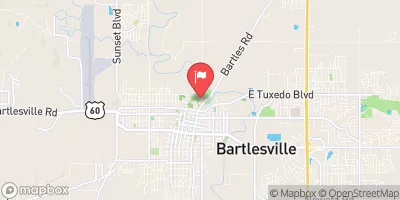 Caney River Above Coon Creek At Bartlesville
|
63cfs |
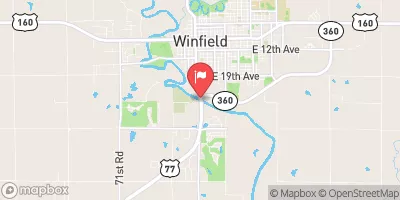 Walnut R At Winfield
|
695cfs |
Dam Data Reference
Condition Assessment
SatisfactoryNo existing or potential dam safety deficiencies are recognized. Acceptable performance is expected under all loading conditions (static, hydrologic, seismic) in accordance with the minimum applicable state or federal regulatory criteria or tolerable risk guidelines.
Fair
No existing dam safety deficiencies are recognized for normal operating conditions. Rare or extreme hydrologic and/or seismic events may result in a dam safety deficiency. Risk may be in the range to take further action. Note: Rare or extreme event is defined by the regulatory agency based on their minimum
Poor A dam safety deficiency is recognized for normal operating conditions which may realistically occur. Remedial action is necessary. POOR may also be used when uncertainties exist as to critical analysis parameters which identify a potential dam safety deficiency. Investigations and studies are necessary.
Unsatisfactory
A dam safety deficiency is recognized that requires immediate or emergency remedial action for problem resolution.
Not Rated
The dam has not been inspected, is not under state or federal jurisdiction, or has been inspected but, for whatever reason, has not been rated.
Not Available
Dams for which the condition assessment is restricted to approved government users.
Hazard Potential Classification
HighDams assigned the high hazard potential classification are those where failure or mis-operation will probably cause loss of human life.
Significant
Dams assigned the significant hazard potential classification are those dams where failure or mis-operation results in no probable loss of human life but can cause economic loss, environment damage, disruption of lifeline facilities, or impact other concerns. Significant hazard potential classification dams are often located in predominantly rural or agricultural areas but could be in areas with population and significant infrastructure.
Low
Dams assigned the low hazard potential classification are those where failure or mis-operation results in no probable loss of human life and low economic and/or environmental losses. Losses are principally limited to the owner's property.
Undetermined
Dams for which a downstream hazard potential has not been designated or is not provided.
Not Available
Dams for which the downstream hazard potential is restricted to approved government users.
 Okla. Land & Cattle Co.