
Mississippi River Locks And Dam 14 Reservoir Report
Last Updated: April 1, 2026
Mississippi River Locks and Dam 14, also known as Pool 14, is a federal-owned structure located in Scott County, Iowa.
Summary
Completed in 1939 by the US Army Corps of Engineers, this concrete dam serves the primary purpose of navigation on the Mississippi River. With a hydraulic height of 11 feet and a structural height of 39 feet, the dam spans 2,874 feet in length and has a spillway width of 1,343 feet. It features two locks, each 600 feet long and 110 feet wide, facilitating the passage of vessels through the river.
This dam plays a crucial role in managing water levels and mitigating flood risks along the river. With a significant hazard potential, the US Army Corps of Engineers closely monitors its condition to ensure structural integrity. The agency implements risk management measures by engaging with emergency managers and the public, updating emergency action plans, and conducting regular maintenance and repairs. Despite the dam's capacity to store water, severe weather events can lead to controlled releases or overwhelming pressures, emphasizing the need for ongoing vigilance and preparedness to address potential emergencies.
Overall, Mississippi River Locks and Dam 14 stands as a vital infrastructure for navigation and flood control in the region. Its strategic location on the Mississippi River underscores the importance of proactive risk management and continuous monitoring to safeguard against potential hazards and ensure the dam's functionality for years to come.
°F
°F
mph
Wind
%
Humidity
15-Day Weather Outlook
Year Completed |
1939 |
Dam Length |
2874 |
River Or Stream |
MISSISSIPPI RIVER |
Primary Dam Type |
Concrete |
Surface Area |
10450 |
Length Of Locks |
600 |
Hydraulic Height |
11 |
Drainage Area |
88400 |
Nid Storage |
82000 |
Structural Height |
39 |
Outlet Gates |
Roller - 4, Tainter (radial) - 13 |
Hazard Potential |
Significant |
Foundations |
Rock |
Nid Height |
39 |
Seasonal Comparison
5-Day Hourly Forecast Detail
Nearby Streamflow Levels
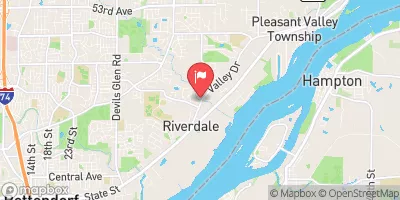 Crow Creek At Bettendorf
|
5cfs |
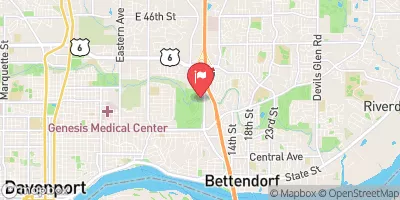 Duck Creek At Dc Golf Course At Davenport
|
63cfs |
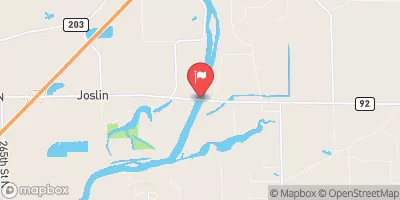 Rock River Near Joslin
|
7620cfs |
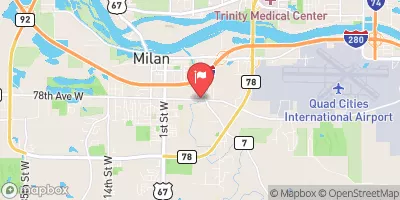 Mill Creek At Milan
|
22cfs |
 Green River Near Geneseo
|
533cfs |
 Duck Creek At 110th Ave At Davenport
|
10cfs |
Dam Data Reference
Condition Assessment
SatisfactoryNo existing or potential dam safety deficiencies are recognized. Acceptable performance is expected under all loading conditions (static, hydrologic, seismic) in accordance with the minimum applicable state or federal regulatory criteria or tolerable risk guidelines.
Fair
No existing dam safety deficiencies are recognized for normal operating conditions. Rare or extreme hydrologic and/or seismic events may result in a dam safety deficiency. Risk may be in the range to take further action. Note: Rare or extreme event is defined by the regulatory agency based on their minimum
Poor A dam safety deficiency is recognized for normal operating conditions which may realistically occur. Remedial action is necessary. POOR may also be used when uncertainties exist as to critical analysis parameters which identify a potential dam safety deficiency. Investigations and studies are necessary.
Unsatisfactory
A dam safety deficiency is recognized that requires immediate or emergency remedial action for problem resolution.
Not Rated
The dam has not been inspected, is not under state or federal jurisdiction, or has been inspected but, for whatever reason, has not been rated.
Not Available
Dams for which the condition assessment is restricted to approved government users.
Hazard Potential Classification
HighDams assigned the high hazard potential classification are those where failure or mis-operation will probably cause loss of human life.
Significant
Dams assigned the significant hazard potential classification are those dams where failure or mis-operation results in no probable loss of human life but can cause economic loss, environment damage, disruption of lifeline facilities, or impact other concerns. Significant hazard potential classification dams are often located in predominantly rural or agricultural areas but could be in areas with population and significant infrastructure.
Low
Dams assigned the low hazard potential classification are those where failure or mis-operation results in no probable loss of human life and low economic and/or environmental losses. Losses are principally limited to the owner's property.
Undetermined
Dams for which a downstream hazard potential has not been designated or is not provided.
Not Available
Dams for which the downstream hazard potential is restricted to approved government users.
Area Campgrounds
| Location | Reservations | Toilets |
|---|---|---|
 Sac-Fox Campground
|
||
 Incahias Campground
|
||
 Wilderness Campground
|
 Mississippi River Locks And Dam 14
 1st Avenue Hampton