

Mississippi River Lock And Dam 9 Reservoir Report
Last Updated: May 3, 2026
°F
°F
mph
Wind
%
Humidity
Mississippi River Lock and Dam 9, also known as Lock & Dam 9 (Winthrop Rockfeller), is a concrete run-of-river dam located in Prairie du Chien, Wisconsin.
Summary
Completed in 1937, this federal-owned structure primarily serves for navigation purposes along the Mississippi River. With a dam height of 18 feet and a hydraulic height of 32 feet, it maintains a constant pool level for river traffic at elevation 619.3, with a maximum discharge capacity of 278,000 cubic feet per second.
Despite being classified as a low-risk dam by the US Army Corps of Engineers (USACE), Lock & Dam 9 faces potential hazards related to the aging miter gates in the locks and the risk of navigation accidents. USACE actively manages these risks through continuous monitoring, prioritizing maintenance activities, and engaging with the public to raise awareness of the dam's presence and potential dangers. The dam's spillway is regulated to control pool levels and can handle flows up to 63,000 cfs, with a maximum water level differential of 9 feet at low river flows. With a risk assessment rating of Very High (1), USACE remains vigilant in ensuring the safety and functionality of Lock & Dam 9 for both navigation and public safety.
Regional Streamflow Levels
 Yellow River At Ion
|
311cfs |
 Kickapoo River At Steuben
|
736cfs |
 Bloody Run Creek Near Marquette
|
30cfs |
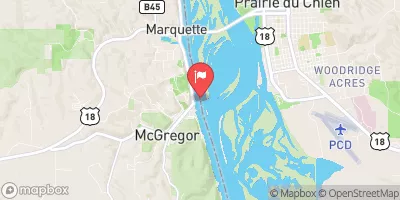 Mississippi River At Mcgregor
|
21700cfs |
 Upper Iowa River Near Dorchester
|
870cfs |
 Turkey River Above French Hollow Cr At Elkader
|
1210cfs |
15-Day Long Term Forecast
Year Completed |
1937 |
Dam Length |
9087 |
Dam Height |
18 |
River Or Stream |
MISSISSIPPI RIVER |
Primary Dam Type |
Concrete |
Surface Area |
29125 |
Length Of Locks |
600 |
Hydraulic Height |
32 |
Drainage Area |
66610 |
Nid Storage |
470000 |
Structural Height |
46 |
Outlet Gates |
Roller - 5, Tainter (radial) - 8, Uncontrolled - 0 |
Hazard Potential |
Significant |
Foundations |
Soil |
Nid Height |
46 |
Seasonal Comparison
5-Day Hourly Forecast Detail
Dam Data Reference
Condition Assessment
SatisfactoryNo existing or potential dam safety deficiencies are recognized. Acceptable performance is expected under all loading conditions (static, hydrologic, seismic) in accordance with the minimum applicable state or federal regulatory criteria or tolerable risk guidelines.
Fair
No existing dam safety deficiencies are recognized for normal operating conditions. Rare or extreme hydrologic and/or seismic events may result in a dam safety deficiency. Risk may be in the range to take further action. Note: Rare or extreme event is defined by the regulatory agency based on their minimum
Poor A dam safety deficiency is recognized for normal operating conditions which may realistically occur. Remedial action is necessary. POOR may also be used when uncertainties exist as to critical analysis parameters which identify a potential dam safety deficiency. Investigations and studies are necessary.
Unsatisfactory
A dam safety deficiency is recognized that requires immediate or emergency remedial action for problem resolution.
Not Rated
The dam has not been inspected, is not under state or federal jurisdiction, or has been inspected but, for whatever reason, has not been rated.
Not Available
Dams for which the condition assessment is restricted to approved government users.
Hazard Potential Classification
HighDams assigned the high hazard potential classification are those where failure or mis-operation will probably cause loss of human life.
Significant
Dams assigned the significant hazard potential classification are those dams where failure or mis-operation results in no probable loss of human life but can cause economic loss, environment damage, disruption of lifeline facilities, or impact other concerns. Significant hazard potential classification dams are often located in predominantly rural or agricultural areas but could be in areas with population and significant infrastructure.
Low
Dams assigned the low hazard potential classification are those where failure or mis-operation results in no probable loss of human life and low economic and/or environmental losses. Losses are principally limited to the owner's property.
Undetermined
Dams for which a downstream hazard potential has not been designated or is not provided.
Not Available
Dams for which the downstream hazard potential is restricted to approved government users.
Area Campgrounds
| Location | Reservations | Toilets |
|---|---|---|
 Frenchman's Landing Campground
|
||
 Camp Terry Hennesy
|
||
 Heffern's Hill Camp
|
||
 Yellow River State Forest
|
||
 Little Paint Creek Campground
|
||
 Brown's Hollow Camp
|
 Mississippi River -- Gordons Bay Landing
River Runs
-
 Western Boundary Of Effigy Mounds National Monument To Boundary Of Effigy Mounds National Monument
-
 The Big Green River
To The River'S Mouth At The Mississippi River
The Big Green River
To The River'S Mouth At The Mississippi River
-
 The "Lower" Dam, Near The Confluence Of Coon Creek To Lane'S Bridge
-
 The Town Of Bluffton To The "Lower" Dam, Near The Confluence Of Coon Creek
-
 Lone Rock
To The Confluence Of The Green And Wisconsin Rivers
Lone Rock
To The Confluence Of The Green And Wisconsin Rivers
-
 The Minnesota-Iowa State Border To Ends Near The Town Of Bluffton, Iowa
 Little Paint Creek
 Hickory Creek
 French Creek
 New Albin Big Lake
 Buck Creek
 Continue with Snoflo Premium